

GHANA POULTRY FARM SOLUTIONS | LIVI POULTRY EQUIPMENT
What Is the Best Layer Cage System for 30,000 Hens in Ghana?
Planning a commercial egg farm with 30,000 laying hens in Ghana? Choosing the right layer cage system will affect your poultry house layout, equipment investment, daily labor, manure management, egg collection, and future expansion. This guide compares A-type and H-type layer cages and explains the practical equipment configuration for a 30,000-bird project.QUICK ANSWER
For a commercial farm with 30,000 laying hens in Ghana, the recommended choice is a 4-tier H-type layer cage system in one poultry house, equipped with automatic feeding, nipple drinking, belt manure removal, egg collection, and suitable ventilation and environmental controls. Using LIVI’s 192-bird H-type cage model, a four-row layout with 40 sets per row provides 30,720 bird positions. A-type cages remain an alternative for lower-budget, divided-house projects, but H-type cages offer a more integrated solution for commercial-scale automation.30,000
Target Layers
160
Example Cage Sets
30,720
Installed Bird Positions
Reference configuration: 4-tier, 4-door H-type cage with 192 birds per set. Final installation quantities are subject to project design and stocking requirements.
1. H-Type vs A-Type Layer Cages: Which Is Better for 30,000 Hens?
Both A-type and H-type layer cages can be used for commercial egg production. However, the best choice depends on flock size, automation requirements, available poultry house space, and the farmer’s investment strategy. For a new farm planning to house 30,000 layers with automatic feeding, manure removal, and egg collection, LIVI generally recommends the H-type system. It provides a compact multi-tier arrangement and allows the main operating equipment to work together within one poultry house.| Comparison | A-Type Layer Cage | H-Type Layer Cage |
|---|---|---|
| Typical Structure | A-frame, 3 or 4 tiers | Vertical H-frame, 4 tiers in this proposal |
| Initial Cage Investment | Generally lower | Generally higher |
| Housing Density | Requires more layout consideration for large flocks | Compact multi-tier arrangement |
| Feeding | Manual or automated options | Suitable for integrated automatic feeding |
| Manure Removal | Scraper or other system options | Integrated manure belts |
| Egg Collection | Manual or system-dependent automation | Compatible with automatic egg collection |
| 30,000-Layer Project | Budget alternative, often with divided houses | Recommended single-house automatic solution |
When Does an A-Type Cage System Still Make Sense?
A-type cages should not be ruled out for every farm. If the buyer already owns two suitable poultry houses, each accommodating approximately 15,000 hens, and has a limited equipment budget, an A-type arrangement may be worth evaluating. However, building a new 30,000-layer project around A-type cages simply to reduce the initial cage purchase price may create additional requirements for poultry house space, manual operation, or separate equipment systems. Buyers should compare the complete investment rather than the cage price alone.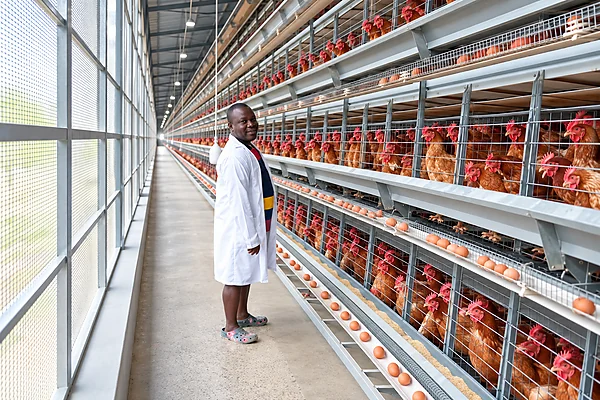
2. How Many H-Type Cage Sets Are Needed for 30,000 Layers?
The correct number of cage sets depends on the actual model capacity. LIVI has different 4-tier H-type layer cage configurations, so a reliable design should start with the number of birds allowed in each set and then arrange the sets into practical cage rows.| H-Type Cage Model | Birds per Set | Minimum Sets | Example Layout | Total Positions |
|---|---|---|---|---|
| 4-tier, 4-door; 1800 × 600 × 430 mm reference cage specification | 192 | 157 | 4 rows × 40 sets = 160 sets | 30,720 |
| 4-tier, 2-door; 1200 × 625 × 480 mm reference cage specification | 144 | 209 | 4 rows × 53 sets = 212 sets | 30,528 |

3. Can 30,000 Hens Be Raised in One Poultry House in Ghana?
Yes. A single poultry house equipped with a suitable 4-tier H-type layer cage system can be designed for approximately 30,000 hens. This is LIVI’s preferred starting arrangement for a new commercial project of this size. However, fitting the required cage positions is only one part of poultry house planning. The complete building must also provide sufficient aisles, maintenance access, feed delivery space, manure discharge, egg collection, ventilation equipment, and structural clearances.What Size Poultry House Is Required?
There is no single poultry house dimension that is correct for every 30,000-layer farm. For example, a row of 40 cage sets using a 1.8-meter reference cage length has a nominal cage-module length of approximately 72 meters before allowances for structural connections, operating equipment, end clearance, and service areas. This is not the overall building length. The width depends on the number of cage rows, cage equipment width, required working aisles, ventilation design, and other services. The height must allow the complete 4-tier system, conveyors, manure equipment, lighting, and suitable clearance for operation and maintenance.- Confirm the actual site dimensions and ground conditions.
- Choose the H-type cage model before fixing the house layout.
- Calculate cage rows and service corridors.
- Allow space for manure and egg collection equipment.
- Design ventilation and cooling around local climate conditions.
- Confirm the building structure and electrical requirements with qualified engineers.
4. What Automatic Equipment Is Needed for 30,000 Laying Hens?
The advantages of an H-type cage system are most noticeable when the cages are installed as part of a complete automatic egg production system. For a 30,000-layer project, the main equipment package should be considered together rather than purchased as separate, unrelated components.| Equipment System | Recommended Configuration | Buyer Should Confirm |
|---|---|---|
| Layer Cages | 4-tier H-type galvanized cage system | Rated bird capacity, material, dimensions and number of sets |
| Automatic Feeding | Feed delivery to all cage rows | Feeding machine, silo, feed transport and controls |
| Nipple Drinking | Nipple drinking lines with pressure regulators | Water quality, filters, pressure control and supply reliability |
| Manure Removal | Automatic manure belts and discharge equipment | Manure handling route and discharge destination |
| Egg Collection | Row egg belts and collection arrangement | Whether central egg collection is included |
| Ventilation & Cooling | Fans, air inlets and cooling equipment where required | Climate calculations and emergency operation |
| Lighting & Controls | Lighting system, controllers and sensors | Included functions and electrical requirements |
Why Are Automatic Manure Removal and Egg Collection Important?
As flock size increases, manure handling and egg collection become major daily operations. Automatic manure belts transfer waste away from the cage tiers, while egg conveyors move eggs toward collection points. When correctly installed and maintained, these systems reduce repetitive manual tasks and make operating procedures more consistent. The equipment still requires inspection, cleaning, maintenance, and trained operators. Automatic equipment does not eliminate the need for farm management.5. Is an H-Type Layer Cage System Suitable for Ghana’s Climate?
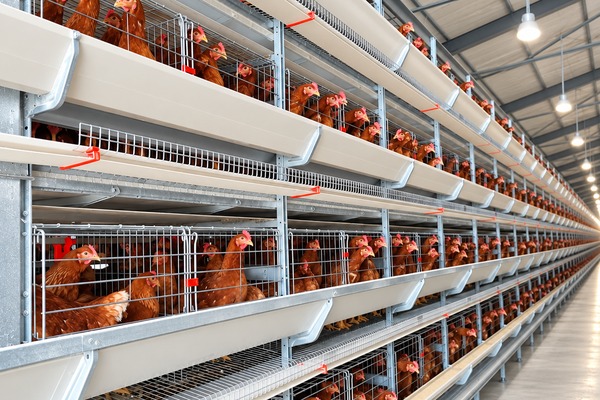
Ghana has different local climatic conditions, including warm and humid periods in southern areas and hot, drier periods in northern areas. A high-density poultry house should therefore be designed around its actual location rather than using one ventilation package for every farm. H-type layer cages can be used in appropriately designed poultry houses, but air movement, temperature control, water supply, and emergency operation are essential considerations. High-density cages must not be installed in a poorly ventilated building simply because the available floor space is sufficient.- Ventilation: Calculate airflow based on flock size, house dimensions and expected heat load.
- Cooling: Evaluate cooling equipment according to the local temperature and humidity.
- Roof and structure: Consider heat gain, rain protection and structural design.
- Power: Provide suitable backup arrangements for critical automatic and ventilation equipment.
- Water: Maintain reliable supply and suitable water quality for the complete drinking system.
- Biosecurity: Separate poultry house operations from contaminated external traffic and manage manure safely.
6. What Should Farmers Know About 30,000-Layer Cage Prices in Ghana?
The best layer cage system is not necessarily the system with the lowest initial quotation. Buyers should compare the total equipment scope, operating requirements, maintenance needs, and the suitability of the design for their poultry house. An H-type system with automatic feeding, drinking, manure removal, egg collection, and environmental controls normally requires a higher initial equipment budget than a simpler A-type cage package. However, the two quotations cannot be compared fairly unless the equipment scope and installation conditions are the same.Factors That Influence the Quotation
- H-type cage model, capacity, material and number of sets.
- Automatic feeding and feed storage configuration.
- Type of egg collection and manure removal equipment.
- Ventilation, cooling, lighting and controller requirements.
- Existing poultry house dimensions or new building plans.
- Shipping terms, packing, installation and commissioning scope.
- Local electrical and water infrastructure requirements.
A More Useful Buying Question
Instead of asking only, “How much does one chicken cage cost?”, ask the supplier: “What equipment, poultry house layout, installation scope, and automation level are included in the proposed 30,000-layer system?”7. A 30,000-Layer H-Type Cage Project Referenced in Ghana
LIVI has previously published a Ghana-focused article describing a 30,000-layer H-type cage configuration with 144 bird positions per set, automatic feeding, nipple drinking, belt manure removal, and automatic egg collection. This earlier configuration provides a useful reference for understanding how an integrated cage system can be arranged for a commercial flock. That published reference uses a different cage model from the 192-bird configuration recommended in this guide. The two designs should not be treated as interchangeable without recalculating the cage sets and confirming the house layout.8. How Can LIVI Help Plan a 30,000-Layer Poultry Farm in Ghana?
A 30,000-layer farm should be planned as a complete operating system. Before confirming equipment quantities, the buyer should establish the available building space, target bird capacity, preferred automation level, and local operating conditions.- Project review: Confirm the farm location in Ghana, target flock size and whether the project is new or an upgrade.
- Cage selection: Identify a suitable 4-tier H-type cage model and rated bird capacity.
- Layout design: Prepare a preliminary arrangement showing cage rows, access aisles and equipment positions.
- Automation package: Configure feeding, drinking, manure removal, egg collection and environmental equipment.
- Quotation: Provide an itemized equipment proposal based on the agreed project conditions.
9. Frequently Asked Questions
Which is better for 30,000 hens in Ghana, A-type or H-type cages?
For a new commercial farm planning full automation, 4-tier H-type layer cages are generally the better choice. A-type cages may be considered for lower-budget projects using two smaller poultry houses.How many H-type cages are required for 30,000 laying hens?
A 192-bird H-type model requires at least 157 sets mathematically. A practical four-row reference configuration uses 160 sets and provides 30,720 bird positions. A 144-bird model requires at least 209 sets, with 212 sets in the example layout.Can 30,000 layers be housed in a single poultry house?
Yes. A suitable H-type cage arrangement can accommodate approximately 30,000 layers in one properly designed poultry house. The building dimensions, ventilation system and service areas must be confirmed through the project layout.What automatic equipment should be included?
The recommended package includes H-type layer cages, automatic feeding, nipple drinking, manure removal, egg collection, lighting, ventilation and suitable environmental controls.What size poultry house is required for 30,000 hens in Ghana?
The dimensions depend on the selected cage model, number of rows, aisle clearances and supporting systems. A custom layout should be prepared before fixing the building length, width or height.Can LIVI provide a farm layout before construction?
Yes. LIVI can prepare a preliminary cage arrangement and equipment configuration after reviewing the planned bird capacity, site dimensions and required automation level.Conclusion: Choose the Cage System Around the Complete Farm
For a new 30,000-layer commercial egg farm in Ghana, a 4-tier H-type layer cage system with integrated automation is LIVI’s recommended starting point. One poultry house can accommodate the planned flock when the cage rows, working space, ventilation and operating equipment are correctly engineered. The next step is not simply to order a number of cage sets. It is to confirm the poultry house conditions, select the cage model, prepare the layout and compare a complete equipment quotation.FREE PRELIMINARY FARM LAYOUT
Plan Your 30,000-Layer Poultry Farm in Ghana
Tell LIVI about your project to receive recommendations for the cage configuration, automatic equipment and preliminary poultry house layout.- Target capacity: approximately 30,000 laying hens
- Project location in Ghana
- Available land or existing poultry house dimensions
- Preferred automatic equipment
- Expected purchasing or construction schedule
You might like:
 How Much Does Poultry Chicken Cage System for Egg Layer Farming Cost?
 How to Choose the Best Chicken Layer Cages for Sale in Zimbabwe?
 5000 Birds Chicken Farm Battery Cage System in Uganda
 Assembly Plan of Ghana H-Type Battery Cage for 35000 Broiler Chickens
 What’s the Best Battery Cage Size for Ghana Farms?