

NIGERIA POULTRY FARM SOLUTIONS | LIVI POULTRY EQUIPMENT
How Much Does a 30,000-Layer Automatic Poultry Farm Cost?
A practical guide to H-type layer cage quantities, automatic poultry equipment, house layout, and project quotations for commercial egg farms in Nigeria.
QUICK ANSWER
How Much Does a 30,000-Layer Automatic Poultry Farm Cost in Nigeria?
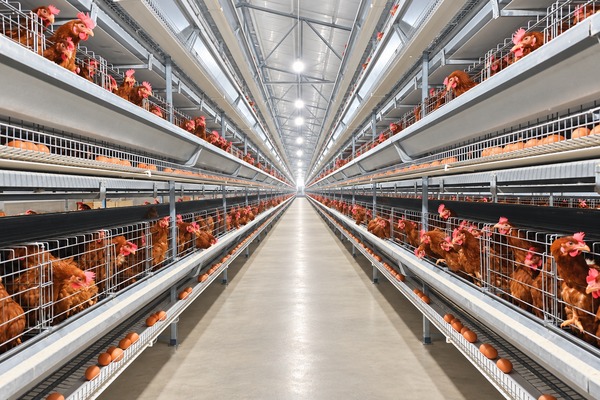
For a 30,000-layer commercial poultry farm in Nigeria, LIVI recommends one poultry house with a 4-tier H-type layer cage system, supported by automatic feeding, nipple drinking, manure removal, egg collection, ventilation, lighting, and environmental controls. With a 144-bird cage model, a four-row layout of 212 sets provides 30,528 installed bird positions. The final 30000 layer poultry farm equipment cost depends on cage specifications, automation equipment, poultry house dimensions, delivery terms, and installation requirements. A project-specific quotation is necessary for reliable pricing.30,000
Target Laying Hens
212
Example H-Type Sets
30,528
Installed Bird Positions
Planning example based on 144 birds per H-type cage set. Final quantities must be confirmed against the selected cage model and poultry house design.
1. What Determines the Cost of a 30,000-Layer Poultry Farm?
When planning a commercial egg farm in Nigeria, the first step is to distinguish the automatic poultry equipment cost from the complete farm investment. These are two different budgets. An equipment quotation may include layer cages and automatic operating systems, while the complete investment may also involve land, poultry house construction, electrical infrastructure, transportation, labor, pullets, feed, and working capital. For a 30,000-layer project, LIVI recommends preparing a detailed equipment list before evaluating the final quotation. This makes it easier to compare suppliers and avoid unexpected additions during installation.Equipment Cost Breakdown
| Equipment Category | Configuration | Main Cost Factors |
|---|---|---|
| H-Type Layer Cages | 4-tier automatic layer cages | Cage dimensions, number of sets, steel specifications, galvanization |
| Automatic Feeding | Feed silos, conveyors, feeding machinery | Number of rows, silo capacity, conveyor length |
| Automatic Drinking | Nipple drinkers, pipelines, water regulation | Water treatment, drinking line arrangement |
| Manure Removal | Automatic manure belts and discharge conveyor | Cage rows, manure conveyor design |
| Egg Collection | Row collection and central collection equipment | Egg conveyor layout and collection requirements |
| Ventilation & Cooling | Exhaust fans, cooling pads where required | Local climate, house structure, airflow requirements |
| Lighting & Controls | Lighting, electric control cabinets and sensors | Automation level and environmental monitoring |
2. How Many H-Type Cage Sets Are Needed for 30,000 Layers?
H-type layer cage quantities depend on the selected model. A commercial farm should calculate the number of cage sets using the actual rated bird capacity of each set rather than assuming all H-type systems have identical dimensions.Option A: 144 Birds per Cage Set
- Cage type: H-type, 4 tiers
- Reference cage dimensions: 1200 × 625 × 480 mm
- Capacity: 144 birds per set
- Mathematical minimum: 209 sets
- Example arrangement: 4 rows × 53 sets
- Total installed capacity: 30,528 birds
Option B: 192 Birds per Cage Set
- Cage type: H-type, 4 tiers
- Reference cage dimensions: 1800 × 600 × 430 mm
- Capacity: 192 birds per set
- Mathematical minimum: 157 sets
- Example arrangement: 4 rows × 40 sets
- Total installed capacity: 30,720 birds
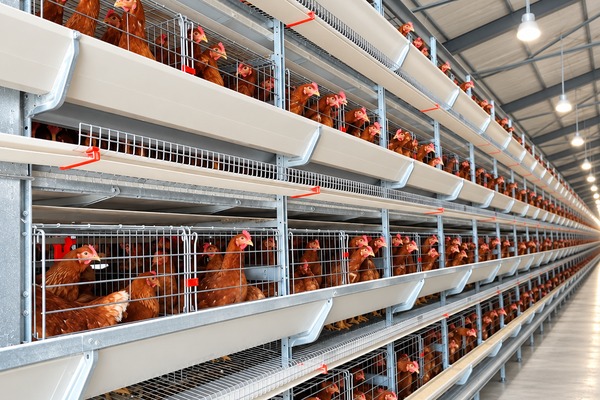
30,000-Layer H-Type Cage Layout
3. What Size Poultry House Is Needed for 30,000 Layers?
For a commercial farm with 30,000 laying hens, one poultry house equipped with a 4-tier H-type cage system is the recommended starting point. This arrangement can simplify daily management, automatic feeding, manure collection, and egg handling compared with dividing the birds between smaller houses. However, there is no universal poultry house length or width that fits every 30,000-layer system. The dimensions should be calculated after confirming the cage model, number of rows, cage-line length, feeding arrangement, ventilation design, and service areas.What Should the Poultry House Layout Include?
- H-type cage row positions and equipment dimensions
- Side aisles and maintenance access
- Automatic feed delivery routes
- Water supply and drinking pipelines
- Manure removal and discharge area
- Egg collection and handling space
- Ventilation, cooling, lighting, and electrical equipment
- Suitable building height and structural clearances
4. What Is Included in a Complete Automatic Layer Cage System?
A fully automatic layer cage system should support the major daily operations of a commercial egg farm. The exact configuration varies by project, but the following systems should be reviewed when planning a 30,000-layer poultry house.Automatic Feeding System
The automatic feeding system transports feed from the storage equipment to the cage rows. A suitable design considers the number of birds, feed distribution uniformity, feeding schedules, and available space for feed storage.Automatic Nipple Drinking System
Nipple drinking equipment supplies water directly to the birds through drinking lines. Water filtration, pressure regulation, and reliable supply are especially important for large poultry farms operating in warm environments.Automatic Manure Removal
Manure belts installed beneath cage tiers move manure out of the cage system. The manure discharge equipment should be coordinated with the poultry house layout, waste handling process, and cleaning schedule.Automatic Egg Collection
Automatic egg collection reduces the need to collect eggs manually from individual cage rows. Depending on the selected package, the system can include row egg conveyors and a central collection arrangement.Ventilation, Lighting, and Environmental Controls
Temperature, airflow, humidity, and lighting affect poultry house operation. In Nigeria, the ventilation and cooling design should reflect the farm location, outdoor climate, building structure, and bird density. Fans, cooling pads, lighting controls, and monitoring equipment should be selected according to the project requirements rather than offered as one fixed package for every location.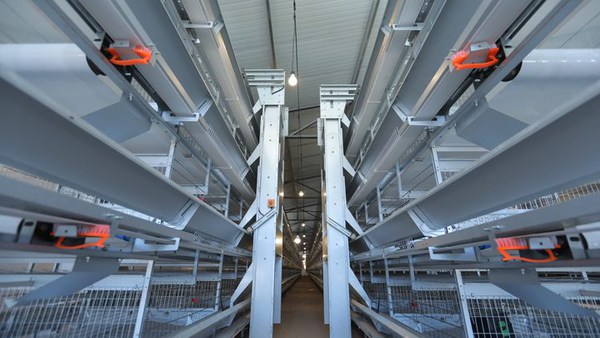
Why Choose H-Type Cages for 30,000 Layers?
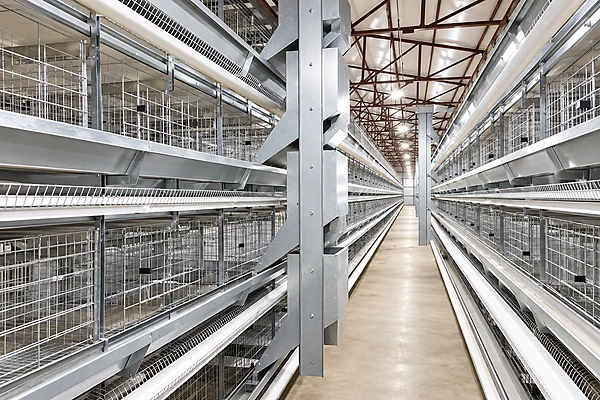
At this commercial scale, H-type cages offer a practical basis for high-density housing and integrated automation. One well-designed poultry house can centralize feeding, drinking, manure removal, egg collection, and routine management. A-type cages may still suit farms with limited investment budgets or projects divided into separate houses. However, for a new 30,000-layer farm targeting a higher level of automation, LIVI generally recommends the H-type solution.5. How Should Nigerian Buyers Compare Poultry Equipment Quotations?
Two quotations for a 30,000-layer poultry project may appear similar but include very different equipment. One supplier may quote only the cage structures, while another includes automatic feeding, manure removal, egg collection, and electrical controls. Before comparing prices, request a clear bill of materials and confirm the following:- The exact cage model, dimensions, tiers, and bird capacity per set.
- The number of cage sets and total installed bird positions.
- Whether feeding, drinking, manure removal, and egg collection are included.
- Which ventilation, cooling, lighting, and control devices are included.
- Whether freight, customs-related charges, installation, and commissioning are included or excluded.
- Requirements for building construction, electricity, water supply, and backup power.
- Available drawings, technical support, warranty conditions, and spare parts.
6. How Does LIVI Prepare a 30,000-Layer Farm Solution?
A reliable equipment proposal should begin with the actual farm conditions, not only the number of chickens. Before preparing a detailed solution, the supplier should understand whether the project is a new farm, an expansion, or a conversion of an existing poultry house.Step 1: Confirm the Farm Requirements
The buyer provides the target number of laying hens, project location in Nigeria, available land or poultry house dimensions, and preferred automation level.Step 2: Select the Cage Configuration
LIVI evaluates the suitable H-type cage model, cage capacity, row arrangement, and equipment quantities. The selected design should provide enough bird positions while allowing appropriate operational access.Step 3: Prepare the Poultry House Layout
The preliminary design identifies the cage rows, feeding and drinking systems, manure discharge, egg collection, and areas needed for environmental control equipment.Step 4: Provide a Project-Specific Equipment Quotation
After the configuration is confirmed, an itemized quotation can identify the cage system and automation equipment, together with the agreed commercial and delivery conditions.Related Poultry Farm Planning Guides
7. Frequently Asked Questions About 30,000-Layer Poultry Farm Equipment
How much does a 30,000-layer automatic poultry farm cost in Nigeria?
The equipment cost depends on the selected H-type cage model, number of cage sets, automation systems, environmental control requirements, delivery conditions, and installation scope. A detailed project-specific quotation is more reliable than a generic package price.How many H-type cage sets are needed for 30,000 layers?
A 144-bird cage model requires at least 209 sets mathematically. A practical example using four rows of 53 sets provides 30,528 bird positions. A 192-bird model can use four rows of 40 sets, providing 30,720 positions. Final quantities depend on the selected equipment and layout.What is included in a complete automatic layer cage system?
A complete system may include H-type layer cages, automatic feeding, nipple drinking, manure belts, automatic egg collection, lighting, ventilation, and environmental controls. Confirm the scope of each system in the equipment quotation.What size poultry house is needed for 30,000 layers?
One H-type poultry house is a recommended planning solution, but its exact dimensions depend on cage length, row arrangement, aisle space, building structure, ventilation equipment, and collection systems. The final dimensions should be established from an engineering layout.Is an H-type cage better than an A-type cage for 30,000 layers?
For a new commercial 30,000-layer farm with higher automation requirements, an H-type system is generally the preferred solution. A-type systems may be considered when the budget is limited and the project is divided between smaller poultry houses.Can LIVI provide a poultry house layout before construction?
Yes. LIVI can prepare a preliminary poultry house layout and equipment configuration based on the planned bird capacity, available land, building dimensions, and farm operating requirements. Final construction dimensions should be reviewed by qualified local engineering professionals.FREE PRELIMINARY POULTRY FARM DESIGN
Plan Your 30,000-Layer Poultry Farm in Nigeria
Are you preparing a new commercial egg farm or upgrading an existing poultry house? Share your farm requirements with LIVI to discuss a suitable H-type cage configuration and complete automatic poultry equipment package.
- Target capacity: approximately 30,000 layers
- Project location in Nigeria
- Available land or poultry house dimensions
- Preferred automation equipment
- Planned purchasing schedule
LIVI Poultry Equipment | Commercial Layer Cage Systems | Nigeria Poultry Farm Solutions


