

Battery Cage vs Deep Litter System in Kenya: Which Is More Profitable for Layer Farmers?
If the goal is simply to start raising chickens with the lowest possible equipment cost, deep litter looks attractive. But once the goal changes to commercial egg production—more birds, stable output, fewer workers, cleaner egg handling and future expansion—the comparison changes completely.
Quick Answer
Deep litter is a lower-entry-cost farming method. Battery cages for layers are a commercial production system. For farms whose target is 10,000 layers or more, the cage system normally creates a stronger business model because it allows more birds in the same building footprint, separates feed, eggs and manure into controlled routes, reduces repetitive labor and makes future automation much easier.
The key profitability question is not “Which system is cheaper to install?” It is “Which system gives me the lowest cost per saleable egg when the farm becomes commercial?”
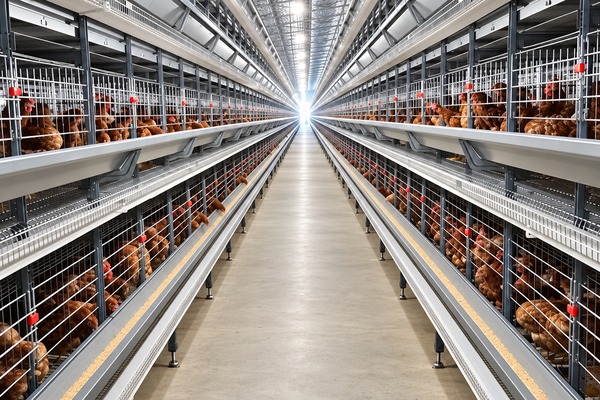
The First Difference: Deep Litter Is a Housing Method. Battery Cage Is a Production System.
In deep litter farming, most daily work still happens inside the same floor space: birds move on the litter, feeders and drinkers sit in the bird area, eggs are collected from nests or the floor, and manure stays mixed with bedding until it is removed.
In a battery cage farm, production is separated into fixed systems. Birds stay in cage rows. Feed moves through troughs. Water comes through nipple lines. Eggs move toward a collection point. Manure drops away from the birds and can be removed by scraper or belt.
The point many new commercial farmers miss
When bird numbers increase, deep litter usually means more floor, more walking, more litter, more nests, more manual collection and more daily management distance. A cage farm scales by repeating standardized rows, equipment and management procedures.
Why This Matters More in a Commercial Layer Farm
More Birds per Poultry House
Cage systems use vertical tiers. The same poultry-house footprint can carry more birds than a floor-based system, reducing the amount of building and land required per bird.
Less Repetitive Manual Work
Feeding, manure removal and egg collection can move from manual tasks to fixed mechanical or automatic systems as the farm expands.
Easier to Manage by Row and Group
Birds, feed, drinking and egg collection are organized in repeatable cage groups instead of one large mixed floor area.
1. Poultry House Cost per Bird: This Is Where the Economics Start to Change
Deep litter may require less equipment, but commercial farmers should also calculate how much poultry-house area is required to carry the planned flock. A system that needs more floor area can shift the “saved equipment cost” into land and construction.
| Question | Deep Litter | Battery Cage |
|---|---|---|
| How is capacity increased? | Mostly by adding more usable floor area | By adding cage rows and vertical tiers |
| Land efficiency | Lower | Higher |
| Building cost per bird | Can rise quickly as capacity grows | Can fall as more birds share the building footprint |
| Future expansion | Often needs another large floor area | Can repeat a standardized cage-house module |
A commercial farmer should compare “cost per bird housed,” not only “cost of chicken equipment.”
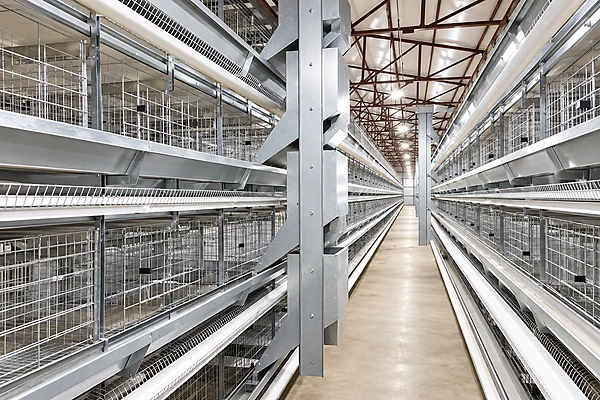
2. Labor: The Cost You Pay Again Every Day
Equipment is normally purchased once and used across multiple production cycles. Labor is paid every month. That is why the economics of automation change as the flock grows.
| Daily Task | Deep Litter | Battery Cage System |
|---|---|---|
| Feeding | Manual or floor feeding line | Fixed feed trough; automatic feeding available |
| Water | Floor drinkers or drinking line | Nipple line integrated into cage rows |
| Egg collection | Workers move through nests / floor area | Eggs move to troughs or egg belts |
| Manure | Litter management and periodic removal | Scraper or manure belt system |
| Bird inspection | Birds move throughout the floor area | Management by cage row and group |
For 500 or 1,000 birds, manual work may still be manageable. For 10,000, 20,000 or 50,000 birds, repeating the same manual task for every bird group becomes a business cost, not just a management inconvenience.
3. Egg Handling: Profit Comes From Saleable Eggs, Not Just Eggs Laid
A commercial layer farm does not earn money from theoretical egg production. It earns money from eggs that reach the customer in saleable condition.
Deep Litter
Eggs may be laid in nests or on the floor. Workers need to collect them frequently. Dirty eggs, floor eggs and breakage add sorting and handling work.
Battery Cage
Eggs roll away from the birds into a front egg trough or belt, separating egg handling from the manure area and reducing unnecessary movement inside the house.
Commercial thinking
If a farm produces thousands of eggs every day, even a small percentage difference in dirty eggs, broken eggs or collection labor becomes meaningful over an entire laying cycle.
4. Feed Management: Small Waste Becomes a Large Number at Scale
Feed is one of the largest recurring costs in layer farming. The question is not only how much feed is purchased, but how consistently it can be delivered and how much is lost during daily feeding.
In a cage system, feed troughs are fixed along each cage row. Mechanical or automatic feeding equipment can deliver feed by row and tier. The feeding route is standardized and separated from bird movement.
A 1% management loss looks small at 1,000 birds. At 20,000 birds, the same 1% becomes a commercial number that repeats every day.
5. Manure Management: Another Reason Commercial Farms Move Toward Cages
Deep litter keeps manure and bedding together until the litter is replaced or removed. The farmer must control moisture and maintain acceptable floor conditions.
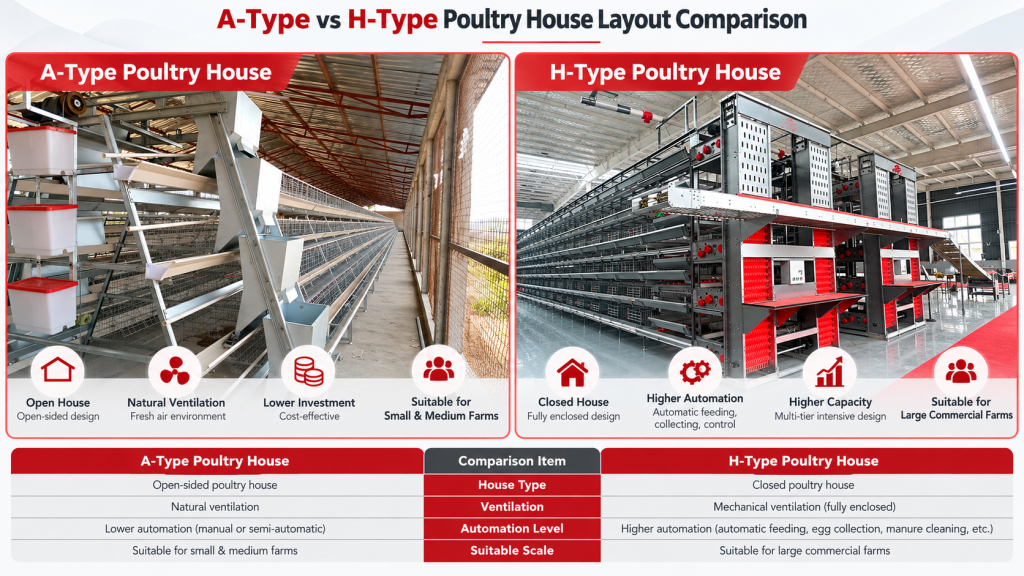
With a cage system, manure is separated from the birds. A-Type systems can use scraper manure removal. H-Type systems can use manure belts on each tier, moving manure out of the poultry house on a planned route.
As stocking capacity increases, this separation becomes more valuable because manure is no longer managed in the same area where birds, feed and eggs are being handled.
6. The Real Business Difference: Variable Cost vs Planned Infrastructure
Lower Investment, More Work Inside the House
It reduces the amount of equipment purchased at the beginning, but more of the production process remains dependent on building area, litter and labor.
Higher Investment, More Work Done by the System
The farmer spends more on infrastructure, but part of the recurring work is converted into fixed equipment: cage rows, feeders, nipple lines, manure removal and egg collection.
This is why cage systems become more attractive as the farm becomes larger: the farmer is not only buying cages—he is replacing repeated manual operations with a production system.
7. At What Scale Does the Decision Change?
There is no single break-even flock size for every farm in Kenya because land, wages, feed prices, egg prices and construction costs vary. But the management logic clearly changes as capacity increases.
| Farm Scale | What Usually Matters Most | Commercial Direction |
|---|---|---|
| Small farm | Starting with the lowest possible investment | Deep litter can be practical |
| Around 10,000 layers | Land use, worker efficiency, egg handling and future expansion begin to matter more | Cage farming becomes a stronger commercial option |
| Around 20,000 layers | Manual feeding, egg collection and manure handling become large daily workloads | H-Type cage + automation becomes the mature commercial direction |
| 50,000 layers and above | The farm must operate as repeatable production units | Full cage system + automation + environmental control |
8. If the Goal Is Commercial Egg Production, What Does the Cage Solution Look Like?
Once the farm’s objective is clear—commercial output, controlled labor and future expansion—the next step is no longer “cage or floor.” It becomes “which cage system and what automation level?”
| Farm Capacity | Mature Cage Direction | Typical Equipment |
|---|---|---|
| 10,000 layers | A-Type layer cage | Nipple drinking + feeding/manure equipment according to project budget |
| 20,000 layers | H-Type 4-tier layer cage | Automatic feeding + drinking + manure removal + egg collection |
| 50,000 layers | Two houses of about 25,000 birds each, H-Type 4-tier | Full automatic equipment + ventilation and environmental control |
9. How Should a Kenya Farmer Compare Profit?
Do not compare only the quotation for cages versus the quotation for feeders and nests. Compare the whole farm over several laying cycles.
| What to Calculate | Why It Matters |
|---|---|
| Poultry-house construction cost | Shows the real cost of floor space per bird |
| Equipment investment | Shows the one-time infrastructure difference |
| Number of workers | Shows recurring labor cost |
| Feed use and feed loss | Shows recurring production cost |
| Dirty / broken / floor eggs | Shows lost saleable output |
| Litter / manure handling | Shows cleaning and waste-management cost |
| Water / power / backup power | Shows operating requirements |
| Expansion cost | Shows what it costs to move from 10K to 20K or 50K birds |
For a commercial farm, the best system is the one that produces more saleable eggs with less land, less repeated labor and more predictable management—not simply the one with the cheapest first quotation.
10. So, Battery Cage or Deep Litter: Which Is the Better Commercial Choice?
Deep litter is reasonable when the priority is low entry cost, small flock size and simple management.
Battery cages are the stronger solution when the goal is commercial layer farming: higher stocking efficiency, standardized feeding and drinking, organized egg collection, separated manure handling, lower dependence on manual work and a clearer path to 20,000, 50,000 birds and beyond.
That is the main difference. One system helps you start raising layers. The other helps you build a repeatable commercial egg-production operation.
Before You Build the Poultry House
The farming system should be selected before the final poultry-house dimensions are fixed. Cage rows, aisle width, feeding equipment, egg collection direction, manure outlet, fans, water and service areas all affect the building layout.
- Planned layer capacity now
- Target capacity in 3–5 years
- Available land size
- Existing poultry-house dimensions, if any
- Labor availability and monthly wage cost
- Water source and storage
- Power and backup generator plan
- Required automation level
FAQ
Is deep litter cheaper than battery cages?
Deep litter normally requires less initial equipment investment. Battery cages require more infrastructure but can reduce land use per bird and make feeding, egg collection and manure removal easier to standardize.
Why do larger layer farms use cage systems?
As bird numbers increase, daily manual tasks become expensive and difficult to manage. Cage systems organize birds into rows and tiers and allow feeding, drinking, manure removal and egg collection to become fixed production processes.
Are battery cages suitable for a 10,000-layer farm in Kenya?
Yes. At around 10,000 commercial layers, land use, labor efficiency, egg handling and future expansion become important enough for cage farming to offer clear operational advantages.
What system is normally used for 20,000 commercial layers?
A mature commercial solution can use an H-Type 4-tier cage system with automatic feeding, nipple drinking, manure removal and egg collection.
Should I build the poultry house before choosing the farming system?
No. The cage rows, working aisles, manure route, egg collection direction and ventilation should be planned before the final building dimensions are fixed.
Compare a Commercial Cage Farm Layout for Your Kenya Project
Send your planned layer capacity + land size or existing poultry-house dimensions + project location + automation target. LIVI can prepare a preliminary cage layout, equipment configuration and poultry-house reference plan before quotation.
You might like:
 Battery Chicken Cages for Sale in Nigeria Boost Poultry Profits in 2025
 Where to Buy the Best Chicken Cages in Ghana for 50000 Poultry Farming?
 Which Type of Chicken Cage Is Best for 50000 Poultry Farm?
 Use poultry farming automation equipment to raise the size of poultry farming
 How Much Does Battery Cage System Cost for 10,000 Layers in Uganda?