

20K Commercial Layer Farm Planning
20K Chicken Farm Solution
For a commercial farm targeting around 20,000 laying hens, Livi Machinery recommends a 4-tier H-type layer cage system combined with automatic feeding, nipple drinking, belt manure removal, automatic egg collection, ventilation, cooling and environmental control.
Using the commonly selected 1200 mm × 625 mm × 480 mm H-type cage with 144 birds per set, the farm can be designed around complete cage rows rather than forcing the final capacity to exactly 20,000 birds. One practical four-row configuration provides approximately 20,160 bird positions.
Around 20,000 layers
1200 mm 4-tier H-type
3–4 H-type cage rows
Fully automatic recommended
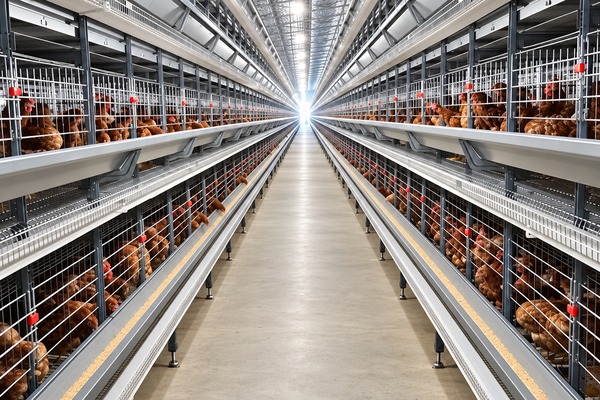
What Does a 20K Chicken Farm Solution Include?
A 20K layer project should be treated as a complete farm system rather than a cage purchase. The poultry house, cage rows, feeding, drinking, manure discharge, egg collection, ventilation and electrical control all affect each other.
| System | Recommended Configuration | Main Function |
|---|---|---|
| Layer cages | 4-tier H-type | High-density bird housing |
| Feeding | Automatic feeding system | Distribute feed to cage rows |
| Drinking | Automatic nipple system | Continuous water supply |
| Manure removal | PP manure belts | Remove manure from each tier |
| Egg collection | Automatic egg belts | Transfer eggs to collection area |
| Environment control | Fans + cooling + sensors | Manage temperature and airflow |
How Many H-Type Layer Cage Sets Are Needed?
The recommended Livi 4-tier H-type layer cage uses a 1200 mm cage module with a reference capacity of 144 birds per set.
Target Birds ÷ 144 Birds Per Set = Required Cage Sets
For a target close to 20,000 birds, the mathematical requirement is about 139 sets. In actual farm design, however, complete and equal cage rows are more important than forcing an exact 20,000-bird figure.
4 rows × 35 sets × 144 birds/set = 20,160 bird positions
This makes the equipment layout more regular and simplifies automatic feeding, manure removal and egg collection.

What Poultry House Design Is Suitable for a 20K Chicken Farm?
Livi Machinery recommends using three or four H-type cage rows for a project around this capacity. Four rows normally create a shorter cage line, while three rows can be useful when the available land is narrower.
In a four-row example using 35 cage sets per row:
After allowing for the feeding end, manure outlet, egg collection equipment, access and maintenance space, a preliminary house length of around 50–55 m can be used for early planning. A four-row house can be studied within an approximate 12–14 m width.
| Layout | House Characteristic | Suitable Situation |
|---|---|---|
| 3 cage rows | Longer and narrower | Limited land width |
| 4 cage rows | Shorter and more compact | Preferred where sufficient width is available |
These dimensions are preliminary references. Final poultry house dimensions should follow the actual Livi Poultry Farm Layout Solution, local climate, construction conditions and ventilation calculations.
Why Use a 4-Tier H-Type Cage for a 20K Layer Farm?
The 4-tier H-type cage is recommended when the farm is designed for commercial production, labor saving and future expansion. Compared with a simpler cage house, it integrates several daily operations directly into the cage structure.
Four tiers improve use of poultry house space.
Each tier can use its own manure belt.
Egg belts move eggs away from cage rows.
The same system can be repeated in new poultry houses.
Buyers can request a customized 20K chicken H-type cage farm solution according to available land and desired installed capacity.
What Automatic Equipment Should Be Included?
For this H-type solution, the recommended configuration is a fully automatic production system. Cage equipment and automation should be quoted together so the correct motors, conveyors, belt lengths and control equipment can be calculated.
| Automatic Equipment | Typical Components |
|---|---|
| Feeding | Feed silo, conveyor, feeding machine |
| Drinking | Nipple drinkers, filters, regulators |
| Manure removal | PP manure belts, motors, cross conveyor |
| Egg collection | Egg belts, elevator, collection conveyor |
| Environment control | Fans, cooling pads, sensors, control cabinet |
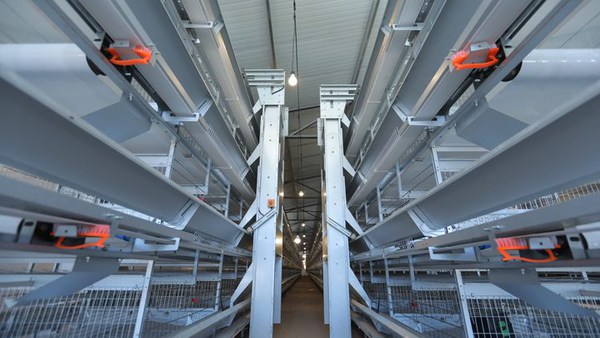
How Should Feeding, Manure Removal and Egg Collection Work?
These three systems should follow clear routes through the poultry house so that one operation does not interfere with another.
Feed Route
Feed silo → feed conveyor → automatic feeding machine → cage troughs
Manure Route
Cage tier → manure belt → cross conveyor → outside manure area
Egg Route
Cage → egg belt → Livi Automatic Egg Collection System → collection area
How Should Ventilation Be Designed for a 20K Chicken Farm?
A 4-tier H-type house has a relatively high stocking density, so mechanical ventilation should be designed from the actual installed bird capacity and poultry house dimensions.
The Livi Ventilation Design Standard can combine exhaust fans, cooling pads, air inlets, temperature sensors and an environmental controller. In hot climates, cooling and reliable backup electricity become especially important.
| Equipment | Purpose |
|---|---|
| Exhaust fans | Remove hot and humid air |
| Cooling pads | Reduce incoming-air temperature |
| Air inlets | Distribute fresh air through cage rows |
| Environment controller | Coordinate ventilation and cooling equipment |
What Determines the Cost of a 20K Chicken Farm Solution?
There is no single fixed price for a 20K farm because two projects with similar bird capacity can require different house layouts and automation configurations.
The main cost variables include H-type cage quantity, number of cage rows, feeding system length, manure belts, egg collection equipment, ventilation, cooling, electrical control, shipping and installation requirements.
When comparing quotations, buyers should verify that every supplier is quoting the same actual bird capacity and the same equipment scope. A lower cage-only quotation should not be compared directly with a complete automatic poultry equipment configuration .
FAQ About 20K Chicken Farm Solutions
Does a 20K farm need to house exactly 20,000 chickens?
No. Twenty thousand birds is usually a planning scale rather than a number that must be matched exactly. The actual installed capacity should follow complete cage rows. For example, four rows with 35 sets of 144-bird H-type cages provide 20,160 bird positions and create a more regular equipment layout.
Which cage does Livi recommend for a 20K commercial layer farm?
Livi Machinery recommends the commonly used 1200 mm 4-tier H-type layer cage when the project is intended as an automated commercial farm. The reference cage size is 1200 mm × 625 mm × 480 mm with 144 birds per set.
Should the farm use three or four H-type cage rows?
Both layouts are practical. A four-row design normally produces a shorter poultry house and is preferred when enough land width is available. A three-row design creates a longer but narrower house. The final choice should follow land dimensions, service aisles and ventilation requirements.
Does a 20K H-type farm need full automation?
Full automation is recommended for this design because the H-type cage structure is already suitable for automatic feeding, drinking, manure belts and egg belts. Automation reduces repetitive work, although workers are still required for bird inspection, system monitoring, maintenance and farm records.
What information is needed to design the project?
Provide the target capacity, land dimensions, country and project location, number of poultry houses, local climate, power voltage, water source, preferred automation level and future expansion target. These details allow the cage quantity, poultry house dimensions and automatic systems to be calculated together.
Planning a 20K Commercial Chicken Farm?
Livi Machinery can calculate the actual installed bird capacity, design a three- or four-row H-type cage layout, plan the poultry house and configure automatic feeding, drinking, manure removal, egg collection, ventilation, cooling and environmental control according to your land, climate and investment plan.
You might like:
 Price of Automatic Chicken Cages For Sale in Nigeria Poultry Farm
 10000 Layer Farm Solution Poultry House Design
 Can Poultry Equipment Supplier Provide Farm Layout and Project Design?
- Battery Chicken Cages for Sale in Nigeria Boost Poultry Profits in 2025
 Shipment of A-Type Poultry Cages for 12,000 Layers to Ghana Successfully Completed