20,000-Layer Farm Decision Guide for Ghana
A-type vs H-type layer cages—which is better for 20,000 layers in Ghana?
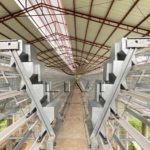
For a commercial farm targeting around 20,000 layers in Ghana, Livi Machinery recommends a 4-tier H-type layer cage system using the commonly used 1200 mm cage module. Although A-type cages can also house this number of birds, H-type cages are more suitable when the project prioritizes automatic feeding, manure removal, egg collection, compact land use, controlled ventilation and future expansion.
Using the Livi 1200 mm H-type cage at 144 birds per set, the farm does not need to be forced to exactly 20,000 birds. A practical four-row layout with 35 sets per row provides 20,160 bird positions, while a three-row design can be used when the available land is narrower.
1200 mm 4-tier H-type
3 or 4 cage rows
20,160 layers
Fully automatic recommended
What Is the Main Difference Between A-Type and H-Type Layer Cages?
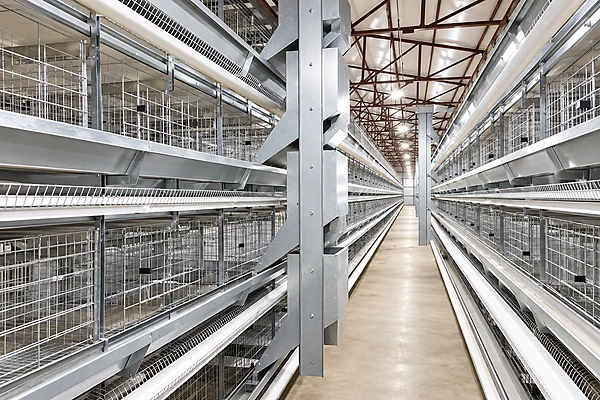
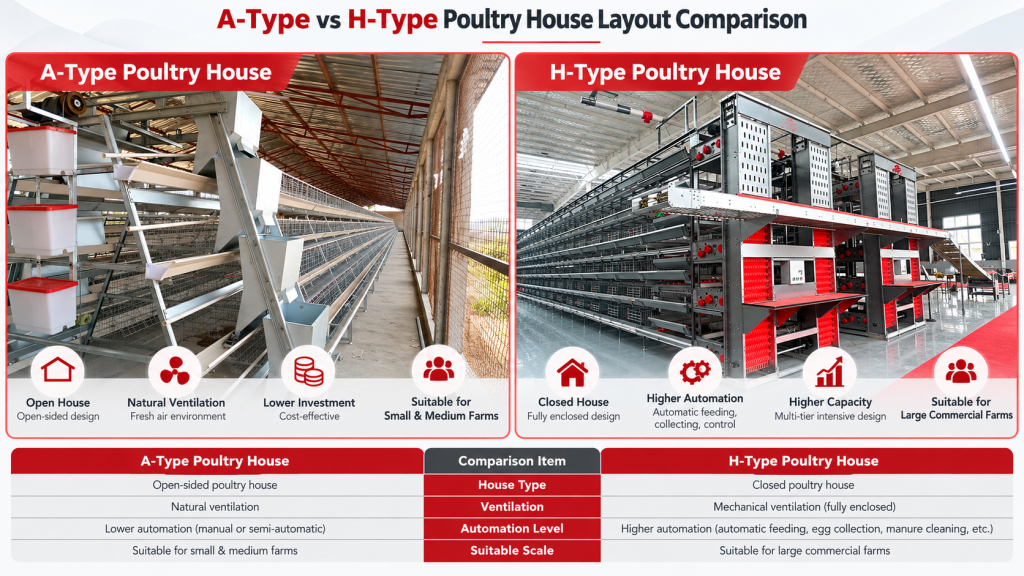
The main difference is not simply cage shape. A-type cages are generally designed for simpler layer farms with lower equipment investment and easier manual access, while H-type cages are designed around higher stocking density and deeper automation.
For a commercial Ghana project targeting around 20,000 birds, the decision should therefore consider labor, available land, manure management, egg handling, power supply, ventilation and future farm expansion—not only the number of hens.
| Comparison | A-Type Layer Cage | H-Type Layer Cage |
|---|---|---|
| Typical structure | A-frame | Vertical multi-tier structure |
| Space utilization | Moderate | Higher |
| Manure removal | Scraper or manual/mechanized options | Tier manure belts |
| Egg collection | Manual or optional automation | Automatic egg belts easily integrated |
| Farm positioning | Simpler investment model | Automated commercial production |
Which Cage System Is Better for 20,000 Layers in Ghana?
For this project, the recommended solution is the Livi 4-tier H-Type Cage System. The purpose is to build a compact commercial layer farm that can use automatic feeding, drinking, manure removal and egg collection from the beginning.
A-type cages remain workable when the owner wants a lower initial equipment investment and expects more manual labor. However, if the 20,000-layer project is intended as a long-term commercial egg farm, H-type cages provide a more suitable platform for automation and future expansion.
Buyers planning an H-type layer cage system for 20,000 layers in Ghana should design the cage rows and poultry house together rather than selecting cage quantity first and building the house separately.
How Many Cage Sets Are Needed for a 20,000-Layer Farm?
Cage quantity should begin with the mathematical requirement, but the final installed capacity should follow complete and regular cage rows.
20,000 ÷ 144 birds/set ≈ 138.9 sets
Instead of forcing the farm into an irregular 139-set arrangement, a practical four-row design can use 35 cage sets in each row:
A three-row house can also be designed if the site is narrower. In that case, cage-line length becomes longer and the final actual capacity should be calculated from equal row lengths.
| Cage System | Birds Per Set | Mathematical Sets for 20,000 | Practical Planning Approach |
|---|---|---|---|
| A-type | 160 | 125 | Suitable if a simpler cage project is preferred |
| 1200 mm H-type | 144 | About 139 | Use equal 3- or 4-row layout and calculate actual capacity |
What Poultry House Design Solution Is Recommended?
For a 20,000-scale H-type layer project in Ghana, three or four cage rows are the preferred layouts. A four-row solution creates a shorter poultry house, while a three-row solution can work better when available land width is limited.
For example, four rows with 35 sets per row create a cage-line length of:
After reserving space for automatic feeding, egg collection, manure discharge, maintenance and access, a preliminary house length of around 50–55 m can be used for early planning. A preliminary width of approximately 12–14 m is suitable for studying a four-row arrangement.
| Layout | Design Characteristic | Recommended Situation |
|---|---|---|
| 3 H-type rows | Longer and narrower house | Limited land width |
| 4 H-type rows | Shorter and more compact cage-line arrangement | Preferred where sufficient width is available |
House dimensions are preliminary planning values. The final Livi Poultry Farm Layout Solution should consider land size, columns, local construction requirements, ventilation calculation and service areas.
How Do Automation and Labor Requirements Compare?
This is one of the strongest differences between A-type and H-type systems. A-type cages can operate with more manual involvement, while H-type cages are designed to connect several daily production processes into one automated system.
| Farm Operation | A-Type | H-Type |
|---|---|---|
| Feeding | Manual-assisted or automatic | Automatic feeding recommended |
| Drinking | Automatic nipple drinking | Automatic nipple drinking |
| Manure removal | Scraper/mechanized | Automatic tier belts |
| Egg collection | Manual or optional automatic | Automatic egg belts |
| Daily worker role | More material handling | More inspection and equipment supervision |
How Should Feeding, Manure Removal and Egg Collection Be Configured?
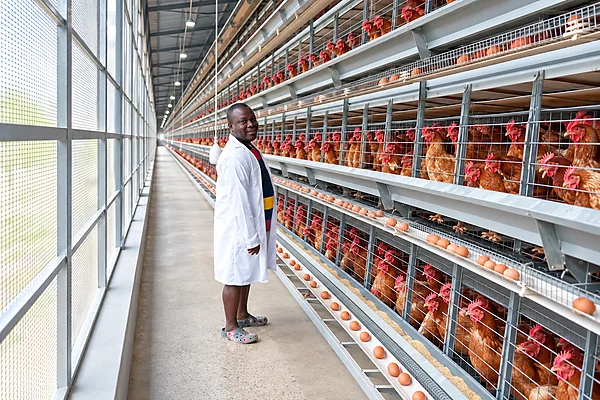
For the recommended H-type solution, these three systems should be designed together because their routes affect the cage layout and poultry house dimensions.
Automatic Feeding
Feed silo → conveyor → feeding machine → feed troughs along each H-type cage row.
Manure Removal
PP belts beneath each cage tier → cross conveyor → external manure handling area.
Egg Collection
Cage egg belt → elevator/collector → collection table or central egg line.
The Livi Automatic Egg Collection System is particularly useful when the owner wants to reduce repetitive egg handling and design the farm for future capacity growth.
How Should Ventilation Be Designed for a 20,000-Layer Farm in Ghana?
Ventilation is particularly important for an H-type project because the cage system concentrates more birds vertically. In Ghana’s warm poultry-production conditions, the house should be designed to remove heat, moisture and manure gases while maintaining airflow through every cage row.
For a fully automated H-type farm, Livi Machinery recommends evaluating a closed or controlled-ventilation house using exhaust fans, cooling pads or controlled air inlets, temperature sensors and environmental control.
| Ventilation Item | Design Function |
|---|---|
| Exhaust fans | Remove heat, humidity and polluted air |
| Cooling pads | Reduce incoming-air temperature when required |
| Air inlets | Distribute fresh air through the house |
| Sensors | Monitor temperature and humidity |
| Environment control | Coordinate fans, cooling and alarms |
Fan and cooling-pad quantities should be calculated from the actual installed capacity, house dimensions and local site climate rather than from “20,000 layers” alone.
What Information Is Needed for a 20,000-Layer Farm Quote in Ghana?
A useful quotation should be based on the real farm design, not only the target number of chickens. The final cage quantity, house size and automation equipment should follow the available land and preferred three- or four-row arrangement.
Capacity
- Approximate target number of layers
- Preferred actual installed capacity
- Future expansion target
Land & Building
- Available land dimensions
- New or existing poultry house
- Preferred 3-row or 4-row layout
Utilities
- Power voltage and frequency
- Backup power
- Water source
Project Location
- Project region in Ghana
- Local climate conditions
- Delivery destination or port
This information allows Livi Machinery to prepare an automatic poultry farm design for 20,000 layers in Ghana with actual cage capacity, poultry house layout, equipment lengths and ventilation configuration.
FAQ About A-Type vs H-Type Layer Cages for 20,000 Layers in Ghana
Which cage system does Livi recommend for a 20,000-layer farm in Ghana?
Livi Machinery recommends a 4-tier H-type layer cage system using the commonly used 1200 mm cage module. For a commercial project, this configuration supports automatic feeding, nipple drinking, manure belts, automatic egg collection and controlled ventilation. It also provides a more standardized platform if the farm expands later.
Does the farm have to house exactly 20,000 layers?
No. Twenty thousand birds is a planning target. The actual installed capacity should follow complete cage rows. For example, four rows with 35 sets of 144-bird H-type cages provide 20,160 bird positions. Using a regular row layout is usually more practical than creating an irregular design only to match exactly 20,000 birds.
How many H-type cage rows should be used?
Three or four cage rows are generally the preferred choices for this scale. Four rows allow a shorter cage line and a more compact house, while three rows can suit a narrower site. The final arrangement should be selected from available land width, ventilation needs, service aisles and future expansion.
Is A-type still suitable for 20,000 layers?
Yes. A-type cages can technically house a farm of this size and may suit buyers who prefer lower initial equipment investment and more manual management. However, for this Ghana commercial-farm design, H-type cages are recommended because they better support manure belts, automatic egg collection, compact land use and a more automated operating model.
What should be designed first: cage quantity or poultry house size?
They should be designed together. Target capacity determines the approximate number of cages, but land dimensions determine whether three or four rows are more suitable. The final poultry house size should then be calculated from cage-line length, aisles, automatic feeding, egg collection, manure discharge and ventilation requirements.
Planning a 20,000-Scale Layer Farm in Ghana?
Livi Machinery can design the project around the 1200 mm 4-tier H-type cage system, calculate the actual installed bird capacity, select a three-row or four-row house layout, and configure automatic feeding, drinking, manure removal, egg collection, ventilation, cooling and installation guidance according to your land and investment plan.