

How Much Does a 30,000-Layer Automatic Poultry Equipment Package Cost in Ghana?
LIVI POULTRY EQUIPMENT | GHANA EQUIPMENT COST GUIDE
How Much Does a 30,000-Layer Automatic Poultry Equipment Package Cost in Ghana?
What is the equipment budget for starting a 30,000-layer automatic egg farm in Ghana? Before comparing prices, buyers must decide exactly what the supplier will deliver: cage structures only, a complete H-type cage package, or a wider farm project including environmental control and construction.
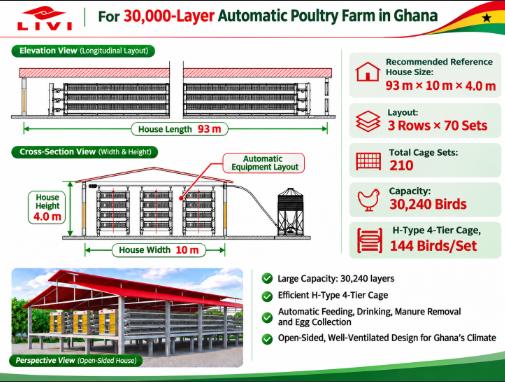
This practical procurement guide uses a documented LIVI reference arrangement of 210 H-type cage sets in three rows, rather than mixing prices from unrelated cage models. It explains the supply scope, cost drivers, quotation format, construction exclusions and the questions that help Ghanaian buyers obtain a comparable offer.
QUICK ANSWER
The cost of a 30,000-layer automatic poultry equipment package in Ghana depends on the H-type cage specification, automatic feeding and drinking systems, manure removal, egg collection, ventilation, shipping terms and installation support. LIVI’s reference design uses 210 four-tier H-type cage sets, rated at 144 birds each, providing 30,240 positions in a 93 × 10 × 4 m poultry house. Buyers should request an itemized equipment quotation and separate it from building construction, freight, import costs, power infrastructure and working capital. Historical project budgets are not current quotations for this configuration.
1. What Does “30,000-Layer Automatic Equipment Package” Actually Include?
The term automatic poultry equipment package does not have a universal supply boundary. An advertised cage price may include only cages and drinkers, while another quotation covers feeding machinery, manure belts and egg belts. Climate-control equipment, a feed silo and a generator may still be priced separately.
| Cost category | Equipment / work to verify | How to classify |
|---|---|---|
| H-type cages | Complete cage sets, supporting structure, troughs and cage fittings | Core cage package |
| Automatic feeding | Feed distribution machinery, motors and controls; check main conveyor and silo | Core automation / optional upstream items |
| Nipple drinking | Nipple lines, regulators, filters and pipes; check tanks and pumps | Core automation / optional water infrastructure |
| Manure removal | Tier belts, drives, cross conveyor and external discharge | Core automation; verify outlet |
| Egg collection | Row belts, elevator/transfer and collection endpoint | Core automation; grading/packing often separate |
| Ventilation and lighting | Fans, inlets, sensors, lighting and cooling as required | Environment package; check separate price |
| Control and electrical | Control cabinet, alarms, cables, installation connections | Define included scope |
| Civil construction | Foundation, columns, roof, floor, drainage | Usually separate from equipment |
| Import and local delivery | Freight, insurance, port charges, duty, taxes, inland transport | Quoted according to terms |
2. What LIVI H-Type Cage Configuration Is Used for This Cost Guide?
LIVI’s reference design for this article uses a 1200 mm, four-tier, two-door H-type layer cage with 144 bird positions per set. The reference cage-unit specification is 1200 × 625 × 480 mm. It is important not to confuse that unit dimension with the full installed height or footprint of an entire four-tier cage set.
| Reference specification | Project data |
|---|---|
| Planned flock | 30,000 laying hens |
| Cage type | 4-tier H-type, 1200 mm model |
| Rated capacity | 144 birds per set |
| Minimum mathematical requirement | 209 sets (30,000 ÷ 144, rounded up) |
| Documented example | 3 rows × 70 sets = 210 sets |
| Installed positions | 210 × 144 = 30,240 |
| Reference house dimensions | 93 m long × 10 m wide × 4.0 m high |
| Reference cage-line length | 70 × 1.2 m = 84 m |
| Installation conditions | Confirm final end space, frame geometry, ventilating arrangement and building structure |
The 93 × 10 × 4.0 m dimensions come from LIVI’s supplied reference drawing for a three-row, 210-set arrangement. They are a practical reference, not an unconditional construction requirement. An accompanying generic H-type calculation rule provides 84 m of cages plus 10 m of end allowances, or 94 m. The one-meter difference requires confirmation of the specific drawing’s end-equipment arrangement before construction.
The older Ghana article based on four rows and 53 sets per row (212 sets, 30,528 positions) represents an alternative planning layout, not the same bill of materials or necessarily the same building. Buyers should not compare total quotations from 210-set and 212-set systems without checking rows, motors, feeding equipment, egg collection and site requirements.
3. How Is the Equipment Cost Calculated?
The correct equipment budget is the sum of all components in the agreed scope of supply, rather than simply multiplying a price per bird by 30,000. For each line item, the poultry equipment supplier should state quantity, specification, unit price, currency and whether installation or transport is included.
Equipment subtotal = cage structures + automatic feeding + drinking + manure removal + egg collection + controls + any agreed ventilation and accessories.
Delivered equipment cost = equipment subtotal + applicable export packing + freight + insurance and other items included under the chosen trade term.
Project investment = delivered equipment + construction + local utilities + installation + import-related costs + initial birds/feed + working capital.
These are different figures. A farm-startup estimate cannot be presented as the cage manufacturer’s EXW equipment price, and an EXW quotation cannot be treated as the all-in cost of opening a poultry farm in Ghana.
4. Is There a Reliable Current USD Price for a 30,000-Layer H-Type Package in Ghana?
Not from the available published material alone. A previously published LIVI Ghana article mentioned a budget of approximately USD 80,000–100,000 for a lower-cost or semi-automatic approach. That article also included equipment and construction component estimates that do not reconcile cleanly with the headline total. It used different cage capacities and scopes, so the figures should not be used as a current price for 210 sets of LIVI’s 144-bird H-type system.
Likewise, broad claims that a fully automatic poultry project can exceed USD 100,000 do not define the contents of a particular 30,000-layer equipment package. Neither historical figure is a verified quotation for this reference design.
For a useful cost answer, ask LIVI to price the 210-set H-type configuration, with separate optional prices for ventilation, cooling, silos, central egg handling, installation and shipping to Ghana. The resulting quotation will provide a real basis for budgeting.
5. Which Factors Make One 30,000-Layer Quotation More Expensive Than Another?
| Cost driver | What changes the cost |
|---|---|
| Cage model and material | Steel specification, corrosion protection, frame construction and spare parts |
| Cage row count | Number of row feeders, end equipment, transfer routes and control arrangements |
| Automation scope | Basic cage/drinking package versus complete feed, manure and egg machinery |
| Ventilation strategy | Open-sided design with suitable controls versus more complex mechanically ventilated configuration |
| Egg handling | Collection at row ends versus central conveying, grading and packing |
| Power and water | Motors, electrical panels, tank/pump/filter requirements and backup arrangements |
| Shipping and delivery | Packing volume, origin/destination, Incoterm, carrier rates and inland delivery |
| Installation | Technical guidance, local labor, travel and commissioning obligations |
A lower price is not automatically better value. Two suppliers may quote a similar flock capacity yet use different cage sizes, coatings, feeding equipment or installation scope. The quotations must be normalized before comparison.
6. What Does the 93 × 10 × 4 m Poultry House Mean for the Budget?
LIVI’s reference layout provides 930 m² of building footprint (93 m × 10 m). This is the nominal building plan area; it is not a price for construction, a measure of total site area or evidence that the same dimensions suit every farm.
Construction planning should separately account for the roof structure, foundation, floor or raised platform, drainage, load-bearing system, rain protection, airflow and biosecurity. A raised open-sided house and an enclosed mechanically ventilated house can have materially different civil and environmental costs even when their cage capacity is similar.
In Ghana, the final ventilation design should reflect the project location, heat, humidity and seasonal weather. Fans and cooling pads should be specified from airflow calculations rather than assigned by a fixed rule based only on bird quantity.
7. Example Itemized Quotation Template for Ghana Buyers
Use the following schedule when requesting quotations from LIVI or comparing suppliers. Blank prices are intentional: they must come from a dated, model-specific commercial quotation.
| Quotation line | Required quantity / basis | Quoted amount (USD) |
|---|---|---|
| H-type cage sets | 210 sets; 144 birds/set | To be quoted |
| Automatic feeding | 3 cage rows; full machine and control scope | To be quoted |
| Nipple drinking | Complete drinking system; define tank/filter exclusions | To be quoted |
| Manure belt removal | 3 rows, tier belts, discharge transfer | To be quoted |
| Egg collection | 3 rows, endpoints and central transfer scope | To be quoted |
| Ventilation, lighting and controls | Based on site and house design | To be quoted |
| Feed silo / water and power options | Specify site-level components | Optional quotation |
| Spare parts and commissioning | Written scope, warranty and service | To be quoted |
| Freight and insurance | EXW / FOB / CIF basis identified | To be quoted |
| Civil works, taxes and working capital | Buyer-side budget, not implied in equipment EXW price | Separately budgeted |
Request a document that identifies the quotation date, currency, product model, bill of materials, exclusions, warranty, production lead time, payment terms and delivery basis. If the offer is CIF, verify the named destination port and the items covered; inland delivery and local customs obligations may still be separate.
8. Can the Farm Use a Cheaper A-Type or Semi-Automatic System?
An A-type or less automated solution can be considered when the buyer prioritizes lower equipment investment or has a suitable existing poultry house. However, it is a separate design choice. A-type cages, scraper cleaning, partial egg collection and different feeding methods have distinct equipment quantities, operating labor and civil layout requirements.
Ask for two clearly separated configurations if you want to compare an H-type automatic system with an A-type alternative. Use the same planned flock, freight basis and explicit list of included systems. Do not replace the 210-set H-type price with a historical A-type budget and present it as equivalent.
9. What Should a Ghana Farm Investor Send to Get a Real Quotation?
- Farm location in Ghana and delivery destination or port.
- Target capacity: approximately 30,000 laying hens.
- Preferred H-type reference: 4 tiers, 144 birds/set, 3 rows × 70 sets.
- Existing house dimensions or available land measurements and project stage.
- Preferred automation scope: feeding, drinking, manure belts and egg collection.
- Ventilation concept, electrical supply, emergency power and water source.
- Whether feed storage, egg grading/packing or manure treatment is required.
- Requested delivery term (EXW, FOB or CIF), installation support and procurement schedule.
LIVI can review these inputs and provide a configuration-based equipment proposal. The final construction layout, ventilation and electrical arrangements should be confirmed by qualified professionals before installation.
10. Frequently Asked Questions
How much does a 30,000-layer automatic poultry equipment package cost in Ghana?
There is no verified single current price for the exact 210-set, 144-bird H-type configuration in the published materials reviewed. Request an itemized quotation for cages, feeding, drinking, manure removal, egg collection and agreed environmental equipment, with freight and construction listed separately.
How many H-type cage sets are required for 30,000 layers?
At 144 birds per set, the mathematical minimum is 209 sets. LIVI’s reference drawing uses 210 sets in three rows of 70, providing 30,240 nominal bird positions.
What poultry house size is recommended for the 210-set layout?
The supplied LIVI standard reference drawing identifies a poultry house measuring 93 × 10 × 4.0 m. Confirm the cage system, structure, ventilation and end-equipment clearances before construction.
Does the equipment price include building construction?
Not unless the commercial quotation explicitly says so. Foundations, roofs, raised platforms, drainage, electrical distribution and other civil works are commonly separate budget items.
Are shipping and Ghana import charges included?
Only to the extent specified by the agreed delivery term and written quotation. EXW, FOB and CIF have different responsibilities, and taxes, customs clearance and inland transport may be separate.
Can an automatic H-type farm use an open-sided poultry house?
An open-sided layout can be evaluated where climate and engineering conditions allow it. The operating environment and equipment configuration should not be copied directly from a closed-house example.
What is the difference between equipment package cost and total farm investment?
Equipment package cost covers the agreed machines and associated supply items. Total farm investment can also include civil construction, local utilities, import-related charges, pullets, feed, staffing and working capital.
Conclusion: Ask for a Price Based on the Actual Cage Layout
The most accurate way to price a 30,000-layer automatic poultry equipment package in Ghana is to start with a defined cage configuration and an itemized bill of materials. LIVI’s documented three-row reference design uses 210 four-tier H-type sets, providing 30,240 bird positions in a 93 × 10 × 4 m reference house.
Rather than rely on inconsistent historical budgets, compare current quotations that clearly distinguish cage equipment, automation, environmental controls, building works, logistics and after-sales support. This gives investors a more useful basis for project decisions.
Related resources: 30,000 Layers Farm Design in Ghana; Battery Cages for 30,000 Layers in Ghana; How to Compare Poultry Equipment Quotations.
Request Your Ghana 30,000-Layer Equipment Quotation
Tell LIVI your project location, house or land dimensions, 30,000-layer capacity and required automatic systems. Request a quotation for 210 H-type sets together with separately listed environmental equipment, delivery and installation options.