Automatic Layer Cage System Cost for 50,000 Hens in Uganda
Planning a 50,000-layer poultry farm in Uganda requires a budget for more than chicken cages. A commercial automatic egg farm needs a compatible H-type cage layout, feeding and drinking equipment, manure removal, egg collection, ventilation, controls, utilities and delivery arrangements. The total cost changes with the equipment specification and whether the farm uses one house or two.
This guide explains what an automatic layer cage system cost in Uganda should include, how to calculate the cage quantities and how to compare two 25,000-layer houses against a single 50,000-layer house. LIVI uses its preferred 1200mm, four-tier, 144-bird H-type model for the reference calculation.
QUICK ANSWER
The cost of an automatic layer cage system for 50,000 hens in Uganda depends on cage specifications, automation scope, house layout, ventilation and shipping arrangements. LIVI recommends its 1200mm, 4-tier H-type cage model with 144 birds per set. A two-house solution with 25,000 layers per house can use 176 sets in each building, providing 50,688 total cage positions. Buyers should compare itemized prices for cages, feeding, drinking, manure removal, egg collection and environmental controls, then separately account for shipping, installation, construction and local infrastructure. A current project quotation is required for an accurate total.
1. How Much Does a 50,000-Layer Automatic Cage Package Cost in Uganda?
There is no reliable single price that applies to all 50,000-layer farms in Uganda. The equipment-only quotation may cover cages and basic drinking, while a complete automatic package may add feeding, manure belts, egg collection, electrical controls, ventilation and selected site-level equipment. Freight, import charges, civil construction and commissioning services can be excluded or priced separately.
Some older LIVI articles give historical budget ranges for 50,000-layer projects in other countries. Those figures are not verified current quotations for the recommended 1200mm, 144-bird cage model in Uganda. Do not copy an old price into a new project budget without checking the complete bill of materials, delivery term and date.
Practical recommendation: Ask for a priced bill of materials divided into House A, House B, shared infrastructure, shipping and project services. This gives the buyer a transparent basis for comparing suppliers and for controlling scope changes.
2. Which H-Type Cage Model and Quantity Should Be Used?
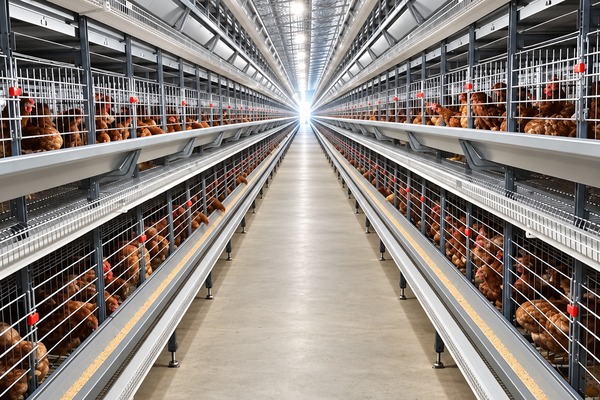
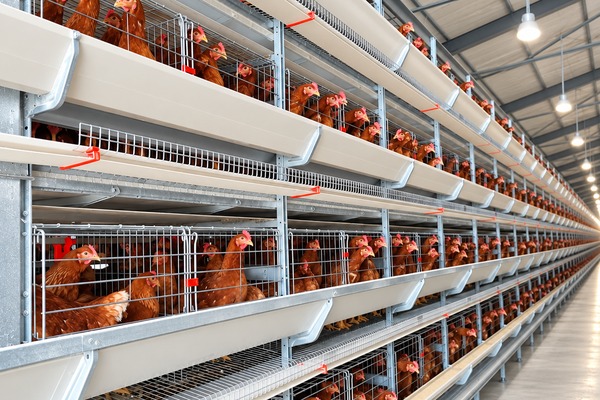
LIVI recommends its 1200mm, four-tier, two-door H-type layer cage configuration with a nominal rating of 144 hens per set. Its reference cage specification is 1200 × 625 × 480 mm. The specification describes a cage unit and must not be used as the complete installed house dimension. The final engineering drawing should show the full cage-set geometry, row arrangement, service space and installed equipment.
For one house, 50,000 ÷ 144 = 347.22, so the mathematical minimum is 348 sets. A four-row arrangement of 87 sets gives 50,112 installed positions. For two houses, each holding 25,000 birds, 25,000 ÷ 144 = 173.61, so at least 174 sets per house are needed. A four-row arrangement of 44 sets gives 176 sets and 25,344 positions per house: 352 sets and 50,688 positions for the farm.
Item
One 50,000-layer house
Two 25,000-layer houses
Target hens
50,000
25,000 per house
Minimum sets
348
174 per house
Example rows
4 × 87 sets
4 × 44 sets per house
Installed sets
348
352 across both
Installed positions
50,112
50,688 across both
House-level systems
One designed package
Independent packages for both houses
These are capacity examples rather than construction-ready row drawings. The actual number of rows and installed cage sets must satisfy site dimensions, applicable stocking requirements, ventilation, maintenance access and the selected equipment specification.
3. Why Can Two 25,000-Layer Houses Cost More Than One 50,000-Layer House?
A two-house farm may use only four more sets than the illustrative one-house plan, but equipment cost is not determined by cage quantity alone. Each building needs suitable feeding distribution, drinking lines, manure belt drives and discharge arrangements, egg collection equipment, lighting, sensors and ventilation controls.
Two independent houses may increase the number of house-level motors, control cabinets, service endpoints or environmental systems. On the other hand, dividing the farm into two production zones can support phased stocking, independent inspection, maintenance and site flexibility. A single house may limit certain duplicated equipment costs but imposes different building and ventilation design requirements.
Central feed storage, water treatment, egg handling, backup power and manure facilities may be shared if their capacity and distribution systems are properly engineered. These decisions should be costed separately rather than assumed to be free or automatically reusable.
4. What Equipment Must Be Included in the Price?
Cost category
Equipment and components
What changes the price
H-type cage system
Frames, mesh, doors, troughs, accessories
Set count, model, steel and coating
Automatic feeding
Row feeders, motors, conveyors, feed transfer
Row length, feed silo scope and number of houses
Nipple drinking
Nipples, lines, regulators, filters
House distribution, water storage and treatment
Manure removal
Tier belts, drives, cross/discharge conveyors
Number of rows and manure discharge distances
Egg collection
Egg belts, elevators, transfer lines
Collection points and central egg handling
Ventilation / controls
Fans, inlets, cooling if required, sensors, lighting, cabinets
Climate, building geometry and independent house control
Project services
Drawings, spare parts, installation guidance
Technical support scope, site and labor responsibilities
5. How Should Automatic Feeding and Drinking Be Budgeted?
A complete feeding quotation should state whether it includes the bulk silo, main feed transfer line, cage-row feeding machinery, motors and controls. The feed system for two houses can sometimes share bulk storage, but each house must receive the necessary distribution equipment and must be able to operate and be maintained safely.
For drinking, compare nipple quantities and line lengths, pressure regulators, filters, water treatment and tank or pump requirements. In Uganda, the farm location and water supply conditions can affect the necessary storage, treatment and backup arrangements. A low-priced cage quotation may exclude these essential components.
6. What Do Manure Removal and Egg Collection Add to the Cost?
H-type layer cages commonly use manure belts under the tiers, together with drive units, cross conveyors and discharge machinery. Price depends on cage-row length, number of houses, discharge direction and the distance to the manure collection area. A buyer should confirm who supplies the equipment beyond the house outlet.
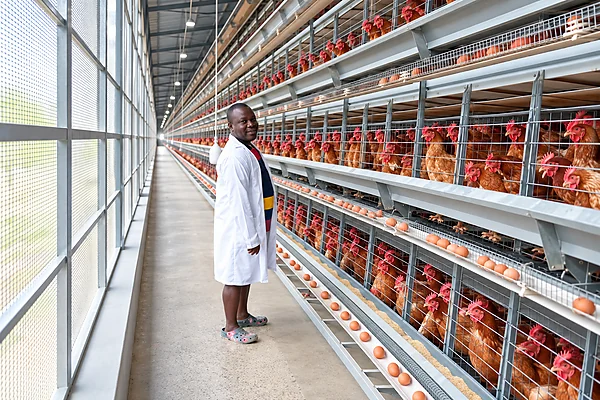
Automatic egg belts transport eggs toward row-end or central collection equipment. Two houses can each have their own collection points and connect to a shared handling room, but the transfer routes and central capacity must be designed for the full production volume. Egg grading, packing and cooling equipment should be identified separately and not assumed included.
7. Does Uganda’s Climate Change the Ventilation Budget?
Yes. Environmental equipment must be selected for the actual farm location, elevation, temperature, humidity, building construction and flock size. The two-house option requires a separately evaluated ventilation arrangement for each building; a single large house needs a different airflow and emergency operating design.
Fans, air inlets, temperature sensors, alarm systems and cooling equipment where appropriate can all affect the budget. Evaporative cooling pads are not automatically suitable for every Uganda site. The final system should be engineered for the local climate, not selected by multiplying an unrelated project’s fan quantity.
Where electricity is unreliable, evaluate backup power and alarms for critical systems, particularly mechanically operated ventilation. The electrical installation and generator capacity require qualified design.
8. What Is Usually Excluded from the Automatic Cage Equipment Package?
Land purchase, earthworks, foundations and poultry house construction.
Electrical supply infrastructure, generator, main distribution and local wiring unless specified.
Water tanks, pumps, treatment systems and utility connections unless specified.
Egg grading, packing and storage rooms or machinery unless included.
Manure storage, transport and treatment beyond the quoted discharge point.
Freight, marine insurance, customs duties, import taxes and destination transport unless covered by the agreed delivery term.
Local construction and installation labor, travel or accommodation for engineers where excluded.
Pullets, feed, staff, veterinary services and farm working capital.
When calculating the total investment, keep equipment supply, buildings and infrastructure, logistics, installation and initial operating capital in separate budget columns. Otherwise, a cage-only quotation can be mistaken for the complete cost of starting an egg farm.
9. How Do EXW, FOB and CIF Affect the Delivered Price in Uganda?
Uganda is landlocked, so an equipment shipment may travel through a seaport in a neighboring country and then by road to the Ugandan destination. The chosen route and delivery term affect who arranges freight, insurance, port handling and inland transport. Do not assume that a quoted CIF price to a named seaport includes customs clearance and delivery to a farm in Uganda.
The quotation should state the exact named location under the applicable Incoterms rule. Confirm the agreed packing, transit arrangement, unloading, import documentation, duties, VAT if applicable, and delivery endpoint with the supplier and a qualified shipping agent.
10. How Can Buyers Get an Accurate, Comparable Quotation?
Send identical project conditions to each supplier. Request separate bill-of-material sections for cage structures, feeding, drinking, manure, egg collection, ventilation, controls, accessories, delivery and technical service. If both one-house and two-house options are possible, ask for both layouts and cost them on the same technical basis.
Buyer input
Example / required detail
Capacity
50,000 laying hens
Location
District or town in Uganda and desired delivery point
Egg handling, manure outlet, maintenance and expansion plans
Quotation terms
Currency, Incoterms, production lead time, exclusions, warranty
LIVI can discuss preliminary H-type cage arrangements and an itemized equipment proposal once these details are confirmed. The final construction, ventilation and electrical designs should be reviewed by appropriately qualified professionals.
Frequently Asked Questions
How much does a 50,000-layer automatic cage system cost in Uganda?
There is no universal fixed current price. A reliable quotation requires cage specifications, one-house or two-house layouts, feeding and drinking equipment, manure removal, egg collection, ventilation, delivery terms and installation scope.
How many 144-bird H-type cage sets are required for 50,000 hens?
The mathematical minimum is 348 sets for one house. For two houses of 25,000 birds, at least 174 sets per building are required. A four-row example uses 176 per house and provides 50,688 total positions.
Is one poultry house cheaper than two houses?
A single building may reduce duplication of house-level systems; two buildings may require separate feeding, manure, egg collection and ventilation equipment. Building and site conditions can change the result. Compare two itemized proposals.
Does the price include a feed silo and automatic egg collection?
Not always. Confirm whether bulk feed storage, feed transfer, egg elevators, collection lines, grading and packing equipment are in the supply scope or optional.
Does an equipment quotation include delivery to Uganda?
Not automatically. Check the Incoterms rule and named place, including which party pays for seaport handling, inland transport, customs clearance and final delivery.
Do two 25,000-layer houses need separate ventilation systems?
Each house needs its own suitable ventilation design and controls. Some farm-level electrical or utility infrastructure may be shared if sized safely.
Can LIVI provide preliminary layouts and a quotation?
LIVI can discuss the cage configuration, automatic equipment scope and preliminary layouts using project capacity, land or house dimensions, location and utility information.
Conclusion: Compare the Full Equipment Scope, Not a Cage-Only Price
For a 50,000-layer automatic egg farm in Uganda, LIVI recommends considering the 1200mm four-tier H-type cage model with 144 birds per set. Both a single-house configuration and two houses of approximately 25,000 hens each may be feasible, but the equipment and infrastructure costs differ.
A two-house reference uses 176 cage sets per building, or 352 across the farm, with suitable automatic feeding, drinking, manure removal, egg collection, ventilation and controls in each house. Request a current itemized quotation that separates house-level equipment, shared facilities, international delivery and local construction. This provides a more dependable basis for investment planning than comparing an isolated per-cage price.
LIVI AUTOMATIC LAYER FARM SOLUTIONS IN UGANDA
Request Your 50,000-Layer H-Type Equipment Quotation
Tell LIVI your project location in Uganda, available land or existing poultry house dimensions, expected capacity and preferred automation level. Ask for a comparison of one 50,000-layer house and two 25,000-layer houses where suitable.


 Automatic egg belts transport eggs toward row-end or central collection equipment. Two houses can each have their own collection points and connect to a shared handling room, but the transfer routes and central capacity must be designed for the full production volume. Egg grading, packing and cooling equipment should be identified separately and not assumed included.
 Efficient Egg Production 20000 Chickens Layer Cage Solution
 H Type Chicken Cage in Nigeria for Commercial Egg Production
 Livi Machinery’s Successful Participation in the Philippines Exhibition 2023
 Zambia Poultry Farming Chicken Layer Cages for Sale
 Battery Cage Price in Nigeria | Layer Cage Cost Guide for Commercial Poultry Farms